What is OLED?
OLED stands for Organic Light-Emitting Diode, a revolutionary display technology that offers better picture quality, thinner designs, and improved energy efficiency over traditional LCDs. At its core, OLED consists of an organic compound layer that emits light in response to an electric current. Unlike LCDs, OLED panels do not require backlighting, which allows them to achieve deeper blacks and better contrast ratios.
Each pixel in an OLED screen is self-emissive, meaning it can turn on and off independently. This results in unparalleled control over brightness and color reproduction. The benefits? You get richer colors, more vivid visuals, and ultra-thin displays. OLED technology has become a mainstay in high-end TVs, flagship smartphones, and even premium laptops.
There are two main types of OLED panels in consumer electronics: rigid OLED and flexible OLED. Rigid OLEDs are built on glass substrates, while flexible OLEDs (like P-OLED) use plastic substrates. The latter provides enhanced durability and flexibility—features that are increasingly important in today’s design-forward devices.
How Does OLED Work?
The operation of OLED is quite fascinating. Each OLED display is made up of several layers, including:
- Substrate (glass or plastic) – the foundation of the display.
- Anode – removes electrons when current flows through the device.
- Organic layers – include a conductive layer and an emissive layer.
- Cathode – injects electrons into the device.
When electricity is applied, electrons and holes (positive charges) move towards the emissive and conductive layers, respectively. When they meet, they recombine and release energy in the form of light. This process is highly efficient and can be tailored to emit different colors based on the materials used.
One of the biggest advantages of OLEDs is their ability to produce true blacks. Since each pixel can be turned off completely, there’s no light leakage—a common issue in LCDs. This gives OLEDs their iconic high-contrast images, making them perfect for HDR content and immersive viewing experiences.
What is P-OLED?
P-OLED, or Plastic Organic Light-Emitting Diode, is a type of OLED display that uses a flexible plastic substrate instead of traditional glass. This switch in base material enables thinner, lighter, and more flexible displays that are both aesthetically pleasing and functionally versatile.
P-OLED vs OLED – Key Differences
While both OLED and P-OLED share the same core technology for light emission, the primary difference lies in the substrate used:
- Traditional OLED: Uses a rigid glass substrate.
- P-OLED: Uses a flexible plastic substrate, typically polyimide.
This simple material swap opens up a new world of possibilities. P-OLED displays are not only bendable and curved, but they’re also more durable, offering resistance to shattering and cracking. This makes them especially valuable in devices like foldable smartphones, smartwatches, and modern vehicles.
Another crucial difference is in the manufacturing process. P-OLED production involves more complex layering techniques to ensure the organic materials bond effectively to the plastic substrate. While this can drive up production costs, the benefits in form factor, resilience, and design flexibility are often worth the trade-off for premium devices.
Composition and Structure of P-OLED
A standard P-OLED display includes the following key layers:
- Plastic Substrate (Polyimide) – This forms the backbone of the display, allowing it to bend and flex.
- Thin-Film Transistor (TFT) Layer – Controls individual pixels.
- Electrode Layers (Anode & Cathode) – Provide the electrical current necessary for light emission.
- Organic Layers – Include the emissive and conductive layers responsible for generating light.
- Encapsulation Layer – Protects the display from moisture and oxygen, which can degrade organic materials.
The use of plastic instead of glass doesn’t compromise display quality—in fact, it enhances the display’s resilience and enables manufacturers to create immersive edge-to-edge or wrap-around displays. With these structural advancements, P-OLED is carving a niche in high-end, futuristic tech designs.
Applications of P-OLED in Modern Devices
1. Smartphones and Wearables
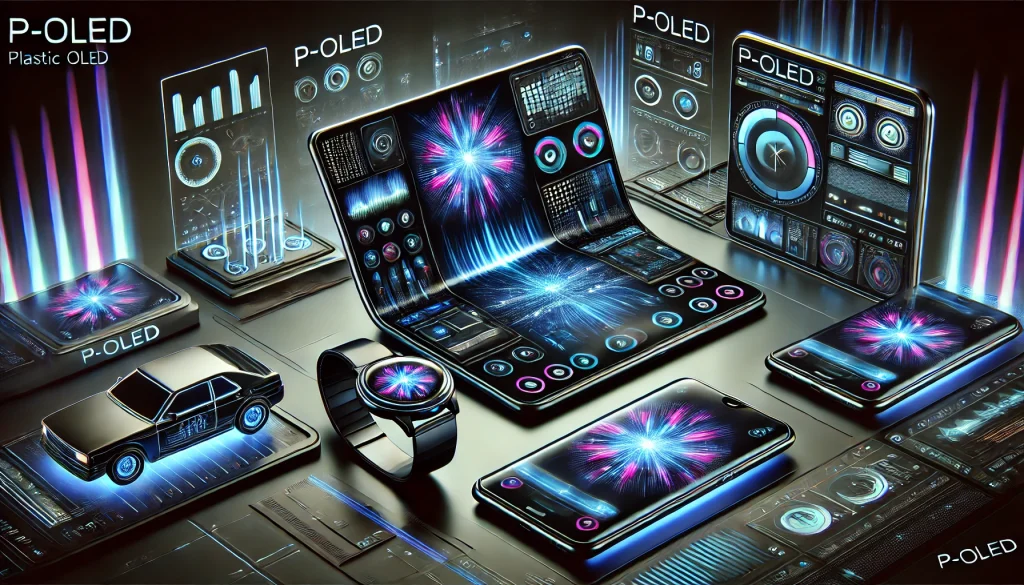
One of the most prominent areas where P-OLED has made a significant impact is in smartphones and wearable devices. Major brands like LG and Motorola have adopted P-OLED for their flagship foldable phones, taking advantage of the technology’s flexibility and vibrant display characteristics. These devices not only showcase futuristic designs but also provide practical benefits like compact portability and robust screens that can withstand daily use.
In the realm of wearables, smartwatches are a perfect match for P-OLED displays. Their curved screens conform to the wrist, offering a more comfortable fit and a sleeker look. Additionally, P-OLED’s power efficiency ensures that battery life is extended—a crucial feature for wearable gadgets that need to run all day on a single charge.
Another key advantage for wearables is outdoor visibility. P-OLED screens offer excellent brightness and contrast, making them easier to read in direct sunlight—an important consideration for fitness enthusiasts and outdoor adventurers.
2. Automotive Displays
The automotive industry is embracing P-OLED technology for both functional and aesthetic reasons. With the rise of smart dashboards and digital cockpits, manufacturers are integrating P-OLED displays into vehicle interiors to create futuristic, user-friendly interfaces. These displays can be curved to match the contour of the dashboard, providing seamless integration and enhancing the overall design.
P-OLED is particularly beneficial in automotive settings because of its resistance to temperature fluctuations and vibrations. Traditional displays can struggle in the dynamic environment of a car, but P-OLED’s durability ensures consistent performance. Moreover, its high brightness and wide viewing angles improve visibility for both drivers and passengers, contributing to safer and more enjoyable driving experiences.
Luxury vehicles often feature multiple P-OLED displays across the dashboard, center console, and rear-seat entertainment systems. This not only elevates the aesthetic appeal but also modernizes the vehicle’s infotainment capabilities.
3. Televisions and Large-Screen Displays
Though less common than in smartphones and wearables, P-OLED is also making its way into television technology. Some high-end TV models use flexible OLED panels to achieve ultra-thin profiles and innovative designs, such as rollable or frameless TVs.
These large-screen applications benefit from P-OLED’s wide color gamut, deep blacks, and superb contrast. The plastic substrate also allows for lighter panels, which are easier to mount and handle, particularly in commercial settings or home theaters.
The immersive quality of a P-OLED TV is unmatched. Viewers enjoy lifelike visuals, whether watching a nature documentary or streaming the latest blockbuster in 4K. Combined with high dynamic range (HDR) capabilities, P-OLED TVs set a new benchmark for picture quality.
P-OLED in Comparison with Other Display Technologies
1. P-OLED vs AMOLED
It’s easy to confuse P-OLED with AMOLED, especially since both technologies stem from the same OLED foundation. However, the key distinction lies in the substrate and manufacturing process. AMOLED stands for Active Matrix Organic Light Emitting Diode, and it typically uses a glass substrate. P-OLED, on the other hand, uses a plastic substrate.
Functionally, both technologies deliver vibrant colors, deep blacks, and fast refresh rates. However, P-OLED is more flexible and lightweight, giving it an edge in foldable and curved device applications. AMOLED panels are generally more rigid, although they are more mature and slightly cheaper to produce at scale.
Another difference is in screen longevity and resilience. P-OLED displays tend to be more durable and less prone to breakage under stress, while AMOLED displays can be slightly more susceptible to screen burn-in over time. Still, both technologies offer high-quality visual performance, and the choice often comes down to use case and design preference.
2. P-OLED vs LCD
The battle between OLED and LCD has been ongoing for over a decade, and P-OLED is turning the tide further in favor of OLED-based technologies. Liquid Crystal Display (LCD) technology has long been the standard for screens due to its affordability and widespread manufacturing infrastructure. However, when compared with P-OLED, it becomes clear why LCD is becoming outdated in high-end devices.
LCD panels require a backlight to illuminate the screen, meaning that all pixels are lit even when showing black images. This results in lower contrast ratios and diminished black levels. In contrast, P-OLED’s self-emissive nature allows each pixel to be controlled independently. Blacks are truly black, and whites are more vivid, leading to significantly better image quality.
From a design perspective, P-OLED wins again. LCDs are rigid, heavier, and thicker because of the multiple layers involved in their construction. P-OLED, thanks to its plastic base, is lighter, thinner, and can be molded into virtually any shape. This flexibility allows for innovative device form factors that simply aren’t possible with LCD technology.
Another key difference lies in viewing angles and refresh rates. P-OLED offers superior viewing from all directions with minimal color distortion and supports faster refresh rates, making it more suited for gaming, AR/VR, and multimedia applications.
In terms of energy consumption, LCDs fall behind. Because of the always-on backlight, LCDs consume more power—especially when displaying darker content. P-OLED, with its pixel-by-pixel control, is much more power-efficient, particularly when used in devices with dark mode features.
Overall, while LCD might still hold a place in budget devices, the future belongs to advanced display technologies like P-OLED that deliver superior performance, design flexibility, and energy savings.
4. P-OLED vs MicroLED
MicroLED is another emerging display technology that is often compared with P-OLED due to its promising attributes. Like OLED, MicroLED is self-emissive, meaning it doesn’t require a backlight and can control individual pixels. But instead of using organic compounds, MicroLED employs microscopic inorganic LEDs that offer superior brightness and longevity.
Where does P-OLED stand in this comparison?
P-OLED excels in flexibility and design freedom, attributes that MicroLED currently cannot match. MicroLED displays are still rigid and in the early stages of commercial viability. Producing MicroLED panels is complex and costly, particularly when it comes to smaller devices like smartphones and smartwatches. P-OLED, on the other hand, is already well-integrated in commercial products, especially wearables and foldable gadgets.
In terms of visual quality, MicroLED holds an advantage in brightness and resistance to burn-in. However, P-OLED still delivers stunning contrast, excellent color accuracy, and deep blacks that are virtually unmatched by any other display technology available today.
From a practical standpoint, P-OLED offers a better balance between performance, manufacturability, and cost. MicroLED is the future, but it’s not quite ready for mass-market deployment. For now, P-OLED remains the more viable and versatile solution for innovative and premium device design.
| Aspect | Advantages 🟢 | Disadvantages 🔴 |
|---|---|---|
| Image Quality | Sharper and more detailed visuals | Some apps may not scale properly at higher resolutions |
| Gaming & Video | Ideal for high-quality gaming and 4K/8K video streaming | Requires a powerful GPU and processor for smooth performance |
| Multitasking | More screen space allows better multitasking and productivity | Small UI elements can be difficult to see without scaling adjustments |
| Professional Use | Perfect for video editing, graphic design, and CAD software | High-resolution monitors are more expensive |
| Battery Life | More efficient for power users who need detailed content | Drains battery faster on laptops, tablets, and smartphones |
| Performance | Enhances immersive experiences in gaming and VR | Higher resolution demands more storage and bandwidth for media files |
| Future-Proofing | Supports upcoming 4K/8K content and new technologies | Not all content is optimized for higher resolutions yet |
Challenges and Limitations of P-OLED
1. Cost Factors
Despite its advantages, P-OLED is not without challenges. The foremost issue is cost. Manufacturing P-OLED displays is still relatively expensive due to the complexity of handling plastic substrates and the need for precise encapsulation technologies. This makes P-OLED less feasible for budget devices or entry-level markets.
Another cost-related factor is the yield rate. Producing flexible displays involves delicate processes that can result in higher defect rates compared to traditional rigid displays. As a result, manufacturers must invest in better quality control systems, which further inflates production costs.
2. Manufacturing Complexities
Working with plastic substrates requires specialized equipment and handling techniques. These substrates are more prone to warping and require advanced layering methods to ensure the display’s performance and reliability. The encapsulation process, which seals the display from environmental factors like moisture and oxygen, must be perfect to prevent degradation of the organic layers.
Additionally, integrating flexible displays into devices requires rethinking other components such as batteries, circuit boards, and housings—making the entire design process more complex.
3. Environmental and Recycling Concerns
Environmental impact is another area of concern. While the use of plastic substrates makes P-OLED displays flexible and lightweight, it also introduces challenges in terms of sustainability and recycling. Plastics are harder to recycle and contribute to electronic waste, raising questions about the long-term environmental footprint of P-OLED technology.
Researchers and manufacturers are exploring biodegradable materials and eco-friendly encapsulation methods, but these solutions are still in development. Until then, the environmental trade-offs of P-OLED remain a topic of debate.
Future of P-OLED Technology
The future of P-OLED is incredibly promising. As innovation accelerates in consumer electronics, automotive design, wearable health tech, and even smart home devices, P-OLED stands poised to be at the center of it all. We’re entering an era where display technologies aren’t just about visual excellence—they must also be smart, flexible, efficient, and durable. P-OLED checks all those boxes.
One exciting direction is the rise of foldable and rollable devices. As manufacturers push the boundaries of form factor, P-OLED is becoming the go-to technology thanks to its bendable, ultra-thin structure. In the near future, we can expect to see more smartphones that fold into tablets, rollable TVs that vanish into consoles, and wearable screens that wrap around arms or clothing.
Another major development is in the automotive industry. With autonomous vehicles and smart dashboards becoming the norm, P-OLED will likely dominate vehicle interiors, delivering interactive, visually stunning, and space-saving solutions.
Sustainability will also play a key role in shaping the future of P-OLED. Innovations in recyclable substrates, eco-friendly encapsulation, and energy-efficient manufacturing methods will be crucial in aligning with global environmental goals.
On the R&D front, partnerships between tech giants, universities, and startups are accelerating advancements in materials science and display engineering. As production costs come down and yields improve, P-OLED will trickle down into mainstream devices, becoming as common as LED screens today.
In short, P-OLED is more than just a display upgrade—it’s a transformative technology redefining how we interact with digital content in every aspect of our lives.
Conclusion
P-OLED, or Plastic Organic Light Emitting Diode, is not just another buzzword in the tech world—it’s a groundbreaking evolution in display technology. By replacing traditional glass substrates with flexible plastic, P-OLED offers an impressive array of benefits: lightweight construction, durability, flexibility, energy efficiency, and superior image quality.
From smartphones and smartwatches to automotive dashboards and foldable laptops, P-OLED is changing how manufacturers design and consumers experience their digital lives. Its ability to bend, curve, and roll gives it a unique edge over traditional LCD and even some OLED variants.
While there are challenges like higher production costs and environmental concerns, the benefits far outweigh the drawbacks. As technology matures and manufacturing scales, these limitations are expected to diminish, paving the way for broader adoption.
Whether you’re a tech enthusiast, product designer, or simply a curious consumer, P-OLED is a technology worth keeping an eye on. It’s not just about what you see—it’s about how you see it, and P-OLED is making that experience more immersive, reliable, and futuristic than ever before.
FAQs
1. What is the difference between P-OLED and AMOLED?
P-OLED uses a plastic substrate, making it flexible and durable, while AMOLED generally uses a glass substrate and is more rigid. Both offer excellent display quality, but P-OLED excels in flexibility and resistance to breakage.
2. Is P-OLED better than LCD?
Yes, P-OLED offers superior image quality, deeper blacks, higher contrast, and better energy efficiency compared to LCD. It’s also thinner, lighter, and more flexible, making it suitable for modern device designs.
3. Are P-OLED displays more durable?
Absolutely. Due to the plastic base, P-OLED displays are more resistant to cracking and can withstand physical stress better than glass-based displays, making them ideal for foldable and wearable devices.
4. Does P-OLED consume less battery?
Yes, P-OLED displays are more energy-efficient because each pixel emits its own light. This eliminates the need for a backlight, especially beneficial for displaying darker content and using power-saving modes.
5. Can P-OLED be used in TVs?
Yes, while not as common yet, P-OLED is starting to appear in high-end, flexible TVs. Its thin profile, flexibility, and vibrant display capabilities make it suitable for rollable or frameless television designs.
6. What are the environmental implications of P-OLED displays?
P-OLED technology offers energy efficiency, which can reduce the carbon footprint of devices over time. However, it also introduces challenges—especially regarding recycling and waste management—because of the use of plastic substrates. These plastics are less eco-friendly compared to glass and may contribute to electronic waste. Manufacturers are actively researching biodegradable materials and sustainable encapsulation techniques to reduce environmental impact in future iterations.